
Singapore · Security officer
Singapore security worker handbook
Your licence route, legal boundaries and decisions on shift
Handbook / 2026.09.20
Edition scope
An independent preparation handbook published by Get Licenced LLC. It summarises selected rules and workplace decisions checked on the date shown. Your approved course, regulator and employer provide the requirements for your role. This handbook and its practice results do not award a licence or authorise physical intervention. Specialist roles, weapons, healthcare and site-specific rules require additional instruction.
For entry-level unarmed security work in Singapore.
Singapore Police Force, Police Regulatory DepartmentChapter 01
Licence, training and deployment
Confirm all three before your first assignment.
Singapore Police Force administers the Security Officer licence. Eligibility includes the permitted nationality or residency and work-pass position, and the authority’s assessment of the applicant. The current licence page states that Malaysian citizens need a valid work pass; the licence itself does not replace permission to work.
Entry-level Security Officers ordinarily need four mandatory WSQ modules: Handle Security Incidents and Services, Provide Guard and Patrol Services, Recognise Terrorist Threats, and Operate Basic Security Equipment. Employers must match deployment to the worker’s grade, qualifications and authorised functions. Specialist screening duties can require additional modules.
- Check eligibility and licence status with Police.
- Complete the modules required for your grade and assignment.
- Ask the employer to verify deployment readiness.
Put it into practice
A licence but missing training
A new licence holder has completed only two of the four required modules.
Complete the outstanding training and ask the employer to confirm readiness before deployment.
Why it mattersLicence approval and training competency are separate conditions.
Official sources: Singapore Police ForceSingapore Police ForceSingapore Police Force
Chapter 02
Authority, arrest and search limits
Keep private-security duties within their legal scope.
Your security role is governed by the Private Security Industry framework, the conditions of your licence and the site assignment. A supervisor’s instruction does not create a power that the law has not granted. Obtain role-specific instruction for any search, screening or intervention task.
Criminal Procedure Code section 66 provides a limited private-person arrest power for an arrestable, non-bailable offence committed in the person’s view or presence, and for a proclaimed offender. Handover to police must follow without unnecessary delay. Other provisions address particular premises and search powers. Routine admission checks based on permission should pause if permission is withdrawn while the matter is escalated safely.
- Distinguish a voluntary entry check from detention.
- Call Police when the basis for intervention is uncertain.
- Avoid borrowing police powers for routine guard duties.
Put it into practice
A supervisor asks for a general search
A supervisor tells you to search every visitor regardless of permission.
Clarify the legal basis, required training and site procedure before carrying out the task.
Why it mattersScreening and coercive searches have different legal conditions.
Official sources: Singapore Statutes OnlineSingapore Statutes OnlineSingapore Police Force
Chapter 03
Professional conduct on duty
Be alert, present and responsive to people who need help.
The Conduct Regulations set specific expectations for licensed officers. Duty includes remaining awake, avoiding alcohol, remaining at the deployment location without an invalid absence and refraining from threatening or abusive language. An officer must respond promptly to a person on the premises requesting help for injury or property damage or loss.
Be honest about your grade, training and skills. Brief the supervisor on limitations or equipment faults before they create a risk. Use the handover process for breaks and relief. If you are exhausted or unwell, tell the supervisor and arrange a safe response through the employer. Do not leave a live post without resolving cover and permission.
- Report fatigue or illness through the workplace process.
- Keep statements about your qualifications accurate.
- Treat requests for help with attention and respect.
Put it into practice
A resident asks for assistance
A resident reports a fall while you are completing paperwork.
Respond promptly, assess the immediate need and obtain help.
Why it mattersThe Conduct Regulations include an explicit duty to respond to relevant requests for assistance.
Official sources: Singapore Statutes Online
Chapter 04
Access control and equipment
Operate within your grade and the site’s instructions.
Obtain the post briefing, authorised visitor process and escalation contacts. Check that the radio, access equipment and any assigned monitoring tools work. Record faults and use the approved contingency process. A worker should receive training before taking on a specialist device or duty.
The licensing conditions link permitted job functions to grade and training. Entry-level SO preparation includes operating basic security equipment. X-ray screening and other specialist screening duties have their own requirements. Learn the approved steps on the equipment at your site, including what to do when an alarm, unclear image or system failure occurs.
- Verify authority before granting access.
- Use only equipment for which the employer confirms training and authorisation.
- Report failures and document the alternative process.
Put it into practice
A new X-ray assignment
You are asked to cover an X-ray screening position without the required module.
Tell the supervisor and ask for a qualified officer or completion of the required training.
Why it mattersSpecialist screening requires the relevant competency.
Official sources: Singapore Police ForceSingapore Police Force
Chapter 05
Report incidents and protect the record
A clear report supports the next person taking responsibility.
Record the time, location, observed behaviour and action taken. Distinguish facts from assumptions and retain original records through the employer’s process. Give Police or SCDF the information needed to find the incident and understand any immediate risk. Preserve relevant CCTV through authorised personnel.
Conduct Regulation 5 creates a specific surveillance-reporting obligation. When a guarding or patrolling officer becomes aware of the surveillance described by that rule, a police report must be lodged without undue delay. The wording was amended in September 2025. Ask your trainer to explain its scope and the employer’s reporting process, while using factual descriptions of behaviour and context.
- Include the basis of each observation.
- Record when Police and supervision were informed.
- Keep security arrangements and reports within authorised channels.
Put it into practice
Possible surveillance of the premises
You become aware of conduct meeting the surveillance conditions explained in your training.
Lodge the required police report without undue delay and inform the employer through its process.
Why it mattersThe statutory duty requires a police report in the circumstances covered by Regulation 5.
Official sources: Singapore Statutes OnlineSingapore Police ForceSingapore Statutes Online
Chapter 06
Personal data and security information
Use information for the authorised task and protect it.
Visitor records, images and incident notes can identify people. The organisation’s PDPA obligations include protection, purpose limitation and retention controls. Follow the approved collection process, give the required information about use and keep records within authorised systems. Refer unusual requests to the supervisor or designated data-protection contact.
Security information also has specific restrictions under the Conduct Regulations. Avoid sharing access codes, camera arrangements or deployment details with unauthorised people. Retention periods depend on the purpose and legal requirements; an officer should not invent a universal deletion period. Report a lost device or mistaken disclosure promptly so the organisation can assess it.
- Verify the requester and authorised purpose before disclosure.
- Keep screens, logs and credentials secure.
- Use the employer’s retention and incident process.
Put it into practice
A neighbour requests camera footage
A resident asks you to send a clip to a personal phone number.
Direct the request through the approved disclosure process.
Why it mattersThe organisation needs to assess authority, purpose and the privacy of everyone shown.
Official sources: Singapore PDPCSingapore Statutes Online
Chapter 07
Emergency assistance and communication
Use precise location details and the right emergency service.
Call 999 for urgent police assistance and 995 for fire or a medical emergency. Give the building or block, road, level, unit and best entrance. Describe immediate hazards and what help is needed. Follow the site emergency plan and dispatcher instructions, and keep access available for responders.
SCDF’s 2026 Emergency Handbook is the local reference for general emergency preparation. Practise the site’s evacuation and assistance arrangements, including support for people who may need help. Give first aid within your current training and avoid entering an uncontrolled hazard. After handover, record the actions taken and any instruction for the next shift.
- Learn the alarm, assembly and responder access arrangements.
- Use clear English and confirm critical messages.
- Report people needing assistance through the emergency coordinator.
Put it into practice
An ambulance needs the entrance
A casualty is on an upper floor of a building with several access points.
Give 995 the floor and unit and arrange safe guidance from the agreed entrance.
Why it mattersPrecise location and access information reduce avoidable delay.
Official sources: Singapore Civil Defence ForceSingapore Civil Defence Force
Chapter 08
Assessment, language and continuing learning
Prepare in English and practise explaining your decisions.
MHA’s August 2026 explanation states that security training and assessment are conducted in English, using oral and written modes with simplified language and pictorial support. This handbook’s knowledge check helps revision. The actual WSQ assessments evaluate the relevant competency through the authorised assessment arrangements.
Renewal includes a separate refresher quiz. MHA’s published format describes 20 randomised multiple-choice questions, and Police requires completion before renewal. The official result has one-year validity. Existing SOs who need OBSE must complete it by 31 December 2026 to remain deployable from 1 January 2027. Verify your personal requirements against your licence date and grade.
- Practise short English reports and emergency messages.
- Use additional-language glossaries as study support where helpful.
- Complete official training and renewal requirements through the authorised route.
Put it into practice
Studying in another language
A learner understands a translated explanation but expects the assessment in that language.
Use the translation for comprehension and prepare the required communication in English.
Why it mattersMHA confirms English as the security training and assessment language.
Official sources: Singapore Ministry of Home AffairsSingapore Ministry of Home AffairsSingapore Police ForceSingapore Police Force
Your assessment route
Singapore security officer knowledge check
20 original study questions on entry requirements and decisions at work. Initial WSQ competency assessment is separate. MHA also publishes a 20-question randomised renewal refresher format, but this study check does not reproduce that quiz or claim its unverified pass standard.
Use the score for revision. The official initial assessment and renewal result must be completed through their authorised arrangements; no official pass threshold is assigned here.
Other training and assessment requirements
Initial training covers the required WSQ competencies and their assessments. MHA confirms English oral and written assessment. Complete the official refresher quiz before licence renewal; Police states that the official result is valid for one year. Check grade and module requirements, including the existing-officer OBSE deadline of 2026-12-31 where applicable.
Test your knowledgeBefore your shift
- Confirm a valid licence, grade and modules for the assigned job functions.
- Check personal training deadlines, including the applicable OBSE transition.
- Read the post orders and remain fit, alert and present at the assigned post.
- Test communications and equipment covered by your training.
- Know the exact block, floor, unit and best entrance for 999 or 995 assistance.
- Confirm the incident and statutory surveillance-reporting process.
- Protect visitor data, CCTV, access codes and deployment information.
- Arrange an authorised relief and clear handover before leaving the post.
Police / fire and ambulance
Use 999 for urgent police assistance and 995 for fire or a medical emergency. Give the block or building, road, floor, unit and safe entrance.
Words you will use
- SO
- Security Officer, the entry grade in the security career and training framework.
- SSO
- Senior Security Officer, a higher grade with additional requirements and permitted job functions.
- WSQ
- Singapore Workforce Skills Qualifications, the competency framework used for the specified security training.
- PWM
- Progressive Wage Model, linking covered security jobs with wage, grade and training requirements.
- OBSE
- Operate Basic Security Equipment, one of the current entry-level competency requirements.
- PRSF
- Perform Remote Surveillance Function, a competency associated with the SSO requirements and current transition arrangements.
- PDPA
- Personal Data Protection Act, which sets organisational duties for handling personal data.
- SCDF
- Singapore Civil Defence Force, responsible for fire and emergency medical response.
- Private-person arrest
- A limited power in Criminal Procedure Code section 66, subject to offence and prompt-handover conditions.
- Refresher quiz
- The authorised online assessment required before licence renewal, separate from initial WSQ competency assessment.
- Security officer / pegawai keselamatan
- English and Malay role terms for study support; official security training and assessment use English.
- Security officer / 保安员
- English and a commonly used Chinese role term for study support; this glossary does not change the official assessment language.
Official sources
Sources checked: 2026-09-20 · Next source review: 2026-12-20
- Criminal Procedure Code 2010 section 66
Singapore Statutes Online · 2026-09-20
- Security Officer licensing conditions
Singapore Police Force · 2026-09-20
- Private Security Industry (Conduct) Regulations 2009
Singapore Statutes Online · 2026-09-20 · Read current version, including amendments effective 2025-09-15.
- Emergency medical services
Singapore Civil Defence Force · 2026-09-20
- Assessment languages and oral arrangements
Singapore Ministry of Home Affairs · 2026-09-20 · Reply dated 2026-08-05: English, oral and written modes, simpler wording and pictorial aids.
- Apply for a Security Officer Licence
Singapore Police Force · 2026-09-20
- PDPA key concepts and obligations
Singapore PDPC · 2026-09-20
- Security Progressive Wage Model training requirements
Singapore Police Force · 2026-09-20 · Existing SO OBSE and SSO PRSF deadline extended to 2026-12-31, for deployment from 2027-01-01.
- Security Officer refresher scenario material
Singapore Police Force · 2026-09-20
- Refresher quiz arrangements
Singapore Ministry of Home Affairs · 2026-09-20 · 20 multiple-choice questions for renewal. Earlier work-pass validity wording is superseded by the current Police licence page.
- Conduct Regulation 5, surveillance reports
Singapore Statutes Online · 2026-09-20 · Amended wording effective 2025-09-15.
- SCDF Emergency Handbook, 10th edition
Singapore Civil Defence Force · 2026-09-20 · 2026 edition.
- Criminal Procedure Code 2010, arrest and search provisions
Singapore Statutes Online · 2026-09-20
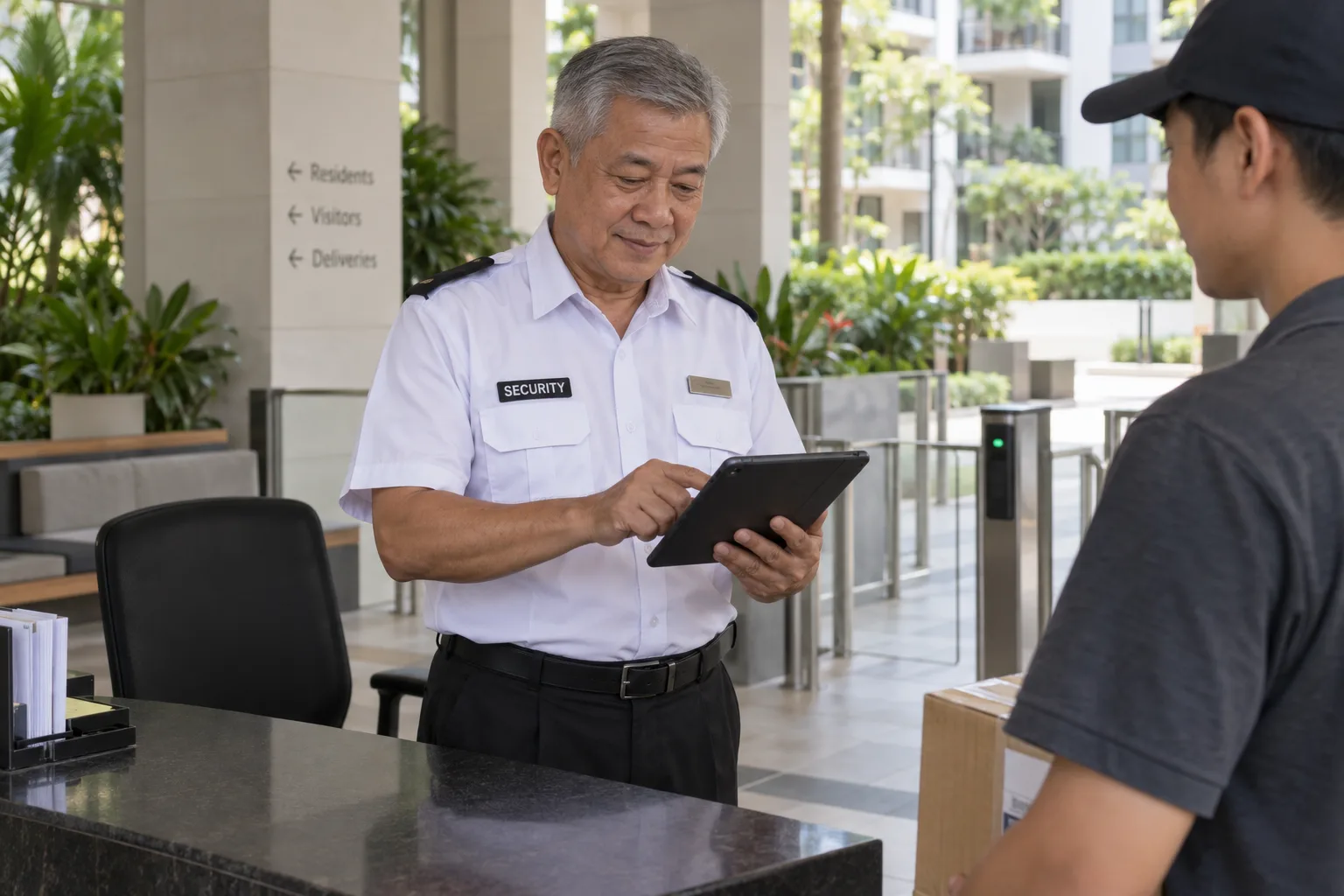
Workplace images are fictional AI illustrations created for Get Licensed. Country imagery reflects the referenced setting.
© 2026 Get Licenced LLC. All rights reserved. Source material retains its own rights.