
France · Agent de prévention et de sécurité
The security worker handbook: France
Understand the role, legal limits and TFP APS assessment.
Handbook / 1.0
Edition scope
Independent Get Licensed handbook, published by Get Licenced LLC. It presents selected rules and workplace situations. Recognised training, practical assessment, SST, CNAPS authorisation and individual legal advice have separate roles. No approval by CNAPS, ADEF or INRS is claimed. Sources checked 20 September 2026. Review scheduled for 1 October 2026 for the Dracar Ultimate deadline; also check RNCP36648 developments before July 2027. This English edition supports study alongside professional French.
France. General human-surveillance route; specialist activities and some territories have additional provisions.
Conseil national des activités privées de sécuritéChapter 01
Entering the profession
Check the route and activity before paying for training.
Agent de sécurité and agent de prévention et de sécurité are common job titles. CNAPS regulates access to private security activities. The usual route involves prior or provisional training authorisation, a recognised qualification, then a professional-card application for the relevant activity. Exceptions apply, including certain national-education diplomas and holders of a valid card.
TFP APS, registered as RNCP36648 until 1 July 2027, is one recognised route. Check the provider’s status and authorised activity. The ADEF programme published in August 2026 provides at least 175 hours, including at least 124 in person and no more than 51 remotely. Assessment includes practical competence.
Professional French is essential for instructions and reports. CNAPS requires foreign nationals, including EU and EEA citizens, to show B1 French using accepted evidence. Residence and suitability conditions depend on the individual case. Ask CNAPS about your own application.
- Verify the qualification and provider.
- Prepare the evidence CNAPS requests.
- Confirm authorised activities before working.
Put it into practice
First training course
A provider offers an immediate start while your authorisation is still pending.
Check the applicable entry requirement with the provider and CNAPS before starting.
Why it mattersTraining authorisation precedes entry for the routes concerned.
Official sources: CNAPSCNAPSFrance compétencesCPNEFP / ADEF
Chapter 02
Your mission and its limits
Prevention, reception, observation and alerting are central duties.
Read the guarded-site boundaries, instructions, reporting line and emergency contacts. Article L613-1 of the Internal Security Code defines the geographical limits of the assignment. Public-road duties require particular conditions and authorisations. A client request alone creates no new legal power.
Appearance and conduct must identify a private service without confusion with public authorities. Respect people, confidentiality and the professional code. A card or authorisation covers specified activities. Fire-safety, airport, dog-handling and armed roles each have additional requirements.
If an instruction appears doubtful, explain the concern and seek supervision. Where a dispute over lawful checks cannot be settled amicably, professional rules provide for calling the competent police or gendarmerie. Record the facts and decisions.
- Read assignment instructions.
- Know the geographical limits.
- Escalate requests outside the mission.
Put it into practice
An expanded patrol
A client requests regular patrols across several nearby streets.
Check the geographical authority and necessary permissions before changing the assignment.
Why it mattersArticle L613-1 governs public-road surveillance.
Official sources: LégifranceLégifranceLégifrance
Chapter 03
Reception, bags and access checks
Distinguish each check and its conditions.
Article L613-2 distinguishes visual bag inspection from searching the bag; searching requires the owner’s consent. Security pat-downs need a specific legal setting, express consent and a person of the same sex. Article L613-3 provides particular conditions for specified events. Explain the check, verify the assignment and apply the relevant conditions.
Since 20 August 2026, L613-2-1 regulates visual inspection of vehicles and boots at specified places and, under conditions, with prefectural authorisation. It requires the site manager’s request and the driver’s express consent. Vehicles fitted for habitation are excluded. Visual inspection gives no authority to search a vehicle.
Apply objective lawful access criteria. Origin, disability or religion creates no automatic reason for suspicion. Use the agreed escalation process where someone declines or disputes a check. For a vehicle check covered by the provision, refusal prevents vehicle entry while preserving the possibility for occupants to enter without it.
- Identify the type of check.
- Verify the legal setting and required consent.
- Record the specific access reason.
Put it into practice
A declined bag search
Someone agrees to show their bag but declines a search of its contents.
Respect the limit of consent and follow the site’s access procedure.
Why it mattersVisual inspection and searching have different conditions.
Official sources: LégifranceLégifranceLégifranceLégifrance
Chapter 04
Apprehension and protection
An intervention carries personal responsibility.
Article 73 of the Criminal Procedure Code covers apprehending the author of a flagrante delicto serious crime or imprisonable offence to bring them before the nearest judicial police officer. A vague suspicion or commercial disagreement does not automatically meet its conditions. Describe what you personally observed and seek police assistance promptly.
Article R631-10 requires immediate notification of police or gendarmerie when a person is retained on this basis. They remain under your supervision and protection. Respect their dignity and summon medical assistance immediately if their condition requires it.
Self-defence of people under Criminal Code article 122-5 requires an unjustified attack, a simultaneous necessary response and no disproportion. Defence of assets has distinct conditions. This manual explains boundaries without teaching physical techniques. Application requires practical training and assessment of the actual situation.
- Establish observed facts.
- Notify competent services without delay.
- Protect dignity and health.
Put it into practice
A person reports pain
After apprehension, the person reports significant pain.
Call the appropriate medical service and inform police.
Why it mattersProtecting the person retained is a professional duty.
Official sources: LégifranceLégifranceLégifrance
Chapter 05
Logs, reports and information
Useful information stays accurate, limited and protected.
The occurrence log and incident report support continuity. Record time, location, observed facts, attributed statements, actions and people notified. Distinguish an observation from testimony and inference. Make corrections traceable within the system in use.
Visitor data, images and reports containing personal information are subject to GDPR. Respect the intended purpose, minimise information collected and use authorised channels. Personal messaging or screen photographs can expose it. Report a mistaken disclosure, loss or unusual access promptly to the responsible person.
CNIL restricts viewing to authorised people carrying out their duties. The controller sets retention according to purpose; a few days often suffice and retention normally remains within one month in the circumstances described by CNIL. Proceedings can require a logged extraction and separate preservation. Follow the rules for the actual system.
Accuracy requirements also apply to patrol records and surveillance screens. Identify a partial view as such. A patrol that did not happen cannot be certified. Records needed for proceedings require authorised preservation and transmission, including identification of the recipient.
- Write specific facts with their source.
- Restrict recipients to authorised people.
- Log authorised footage extraction.
Put it into practice
A colleague requests a clip
A colleague wants to save an incident on a personal telephone.
Use the authorised extraction procedure and decline a personal copy.
Why it mattersRetention and access must follow the purpose and authorisations.
Official sources: European UnionCNILLégifranceCPNEFP / ADEF
Chapter 06
Communication under pressure
Listening and clear instructions support cooperation.
Introduce yourself, briefly explain the request and listen. Use understandable language, one question at a time and a steady tone. Apparent refusal may reflect hearing difficulty, misunderstanding or conflicting instructions. Check before drawing conclusions.
In conflict, offer choices permitted by site rules. Arrange colleague support and avoid several people issuing different directions. Preserve a safe opportunity to move away according to training. Adapt alerts and protective action as the risk changes.
Risk management includes recognising your own stress. Calm breathing, checking your understanding and a short discussion with a supervisor can improve decisions. In the debrief, identify observed signs and what helped or hindered communication. These exercises support the practical skills assessed in training.
Describe observed behaviour with its time and context, and identify inferences. When language or hearing affects communication, simplify the message and check understanding. A disability-related request calls for checking planned access arrangements and directing the person to an authorised accessible solution. The same objective criteria should guide comparable situations.
- Check understanding.
- Coordinate team communication.
- Report changes in risk.
Put it into practice
An instruction is misunderstood
A person keeps identifying the wrong entrance after your explanation.
Explain again in simple language and provide an accessible direction.
Why it mattersChecking understanding can prevent a difficulty becoming a conflict.
Official sources: CPNEFP / ADEFLégifranceLégifrance
Chapter 07
Emergencies, fire and assistance
Protect, alert and apply the skills you have learned.
Before duty, locate alarms, communications, exits, assembly points and responder access. During an accident prevent a further incident and alert through site arrangements. 112 is the European emergency number; in France 15 reaches SAMU, 17 police or gendarmerie and 18 the fire service.
Give a precise location, the event, hazards and number of people affected where known. Follow the dispatcher’s questions. First-aid actions require training through an authorised instructor and must stay within learned competence. SST certification has its own validity and refresher requirements.
For a developing fire, electrical installation or hazardous substance, follow site alerts and protective procedures. Equipment intervention requires training, authorisation and safe conditions. Asset protection must not expose someone to additional danger. Distinguish fire-safety specialisms from the APS assignment.
For fire, apply the site’s alarm, external alert and evacuation or protected-area arrangements. A violent attack calls for specific official instructions: the government guidance updated in June 2026 prioritises safe escape, then shelter and alerting. Distinguish the situations when selecting the alarm procedure. Physical actions require suitable practical training.
The assembly point is used to gather and account for evacuated people. Assistance needs must be included in the plan, with protected waiting areas where provided. Report obstructed escape routes and arrange restoration of a safe solution through responsible staff. Initial fire response depends on training, suitable equipment and conditions allowing safe action.
For an attack, government guidance prioritises escape where possible without immediate danger, leaving belongings behind. If escape is impossible, seek shelter, remain discreet and silence your phone. Once safe, tell responders the location, type of event and observed facts. Follow authorities and facilitate access. Automatically triggering the fire alarm is unsuitable for this situation.
For prevention, use the current Vigipirate context and approved site instructions. Reports describe observed behaviour or objects in context. Origin or religion does not establish a threat. Avoid touching a suspicious object, protect the area under instructions and alert help; technical identification belongs to competent responders.
- Know responder access routes.
- Give a precise alert.
- Work within your training.
Put it into practice
A collapse at reception
A visitor collapses while the reception area remains crowded.
Alert assistance, make responder access easier and apply actions covered by your training.
Why it mattersEmergency arrangements combine protection, alerting and assistance.
Official sources: INRSINRSLégifranceCPNEFP / ADEFINRSGouvernement françaisSGDSNINRSGouvernement françaisSGDSNLégifrance
Chapter 08
Patrols, alarms and the security control room
A useful check leads to traceable action.
Start with instructions, previous incidents, keys and communications checks. On patrol, examine access points, anomalies, exits and risks covered by the assignment. Report departures from the expected condition and log your checks.
An alarm needs assessment suited to the system and procedure. Identify its origin, available information and authorised actions. Statutory verification rules for remote monitoring have a particular scope. Where a person faces immediate danger, follow emergency arrangements without waiting for an administrative formality.
A suspicious object, leak or electrical hazard calls for safety precautions and alerting. Handling a dangerous object or improvising a repair can worsen events. Industrial-site induction, equipment and permissions must reflect the actual hazards. Pass relevant information to the incoming team.
Alarms, video and lone-worker alert devices need checks and an identified response chain. Report faults and arrange authorised alternative protection where necessary. On industrial sites, respect restricted zones, substance-related instructions and work permits. The employer issues electrical authorisation for defined tasks; a security role gives no universal electrical authority.
At reception, check authorisation through the designated channel even when someone names a familiar manager. A lost badge needs reporting and deactivation under procedure before controlled replacement. For a key loan, record the authorised recipient, reference, time and return. An urgent request through an unusual channel still requires verification of the requester’s identity and authority.
At control, identify an alarm by zone, type and time. Apply risk-based priorities and request support before exposed verification. An unknown cause remains open until resolved or explicitly handed over. During a threatening call, stay calm, collect available information and pass on facts and uncertainty. The final record gives checks, actions and resulting status.
For events, identify ticket categories, entrances, exits and responsibilities. Ticket anomalies go through authorised verification. Queues must leave emergency routes clear; alert colleagues and regulate flow under the plan. Establish channels and escalation contacts across teams. In an industrial alert, the hazard-specific procedure may differ from ordinary evacuation.
- Check equipment at handover.
- Locate and describe anomalies.
- Record action and hand over.
Put it into practice
A recurring alarm
A detector activates repeatedly and a colleague suggests disabling it.
Report the fault and follow the authorised procedure for that system.
Why it mattersInformal disabling may remove essential protection.
Official sources: CPNEFP / ADEFLégifranceLégifranceINRSINRS
Chapter 09
Working life and renewal
Track your card, competence and rest.
Check the employment contract, applicable collective agreement, rota and arrangements for breaks, rest, overtime and night work. General rules allow regulated exceptions. Report serious fatigue, missing relief or an unsafe instruction. Keep reliable working-time records.
The professional card lasts five years. CNAPS requires renewal at least three months before expiry and does not consider applications made more than six months ahead. For human guarding, MAC training must fall within the 24 months before card expiry. Check each activity and its dates in Dracar Ultimate.
Continued work after expiry requires a valid document authorising it; submission of an application alone is insufficient. Renewal receipts have conditions and issuing one is separate from submitting the application. Once a card has expired, MAC entry procedures change. Consult CNAPS before resuming.
Upcoming checkpoint: on 17 September 2026, CNAPS reminded relevant businesses to create their Dracar Ultimate account and register employees by 1 October 2026. Specified overseas territories have a separate deadline. Ask the employer to confirm your record has been linked. This business filing requirement does not replace a valid personal authorisation.
- Check each validity date.
- Schedule MAC and renewal.
- Record working time and relief.
Put it into practice
A card nearing expiry
Your card expires in four months.
Check the required MAC and prepare a complete renewal application now.
Why it mattersThe filing window and evidence affect continuity of work.
Official sources: CNAPSService PublicService PublicLégifranceCNAPSCNAPS
Chapter 10
Preparing for TFP APS assessment
Practise knowledge and workplace situations.
The ADEF framework specifies 99 single-answer questions in ten groups: UV2 15, UV3 10, UV4 5, UV5 5, UV6 8, UV7 10, UV8 15, UV9 8, UV10-12-14 15 and UV11 8. Each assessed group needs 12/20. A high overall average cannot replace passing each unit.
First aid is assessed through INRS procedures. UV13-15 includes two practical scenarios, one at a control room and one on patrol, followed by a written incident report. The rulebook recommends at least 15 minutes per candidate for the practical arrangement described. Dangerous conduct can be disqualifying.
Our exercise uses original questions and the published number in each group. An official QCU time limit was not established in the public sources checked, so the exercise has no official countdown. Results identify topics for further study. They do not validate practical skills, SST or certification. The English edition supports understanding; practise conversations and reports in French too.
- Study every unit individually.
- Prepare practical assessment with the provider.
- Read explanations and sources after the quiz.
Put it into practice
A strong overall average
Your total looks satisfactory but one unit is below 12/20.
Revisit that unit and confirm resit arrangements with the provider.
Why it mattersQCU units are assessed individually, without general compensation.
Official sources: CPNEFP / ADEFFrance compétencesINRS
Your assessment route
TFP APS single-answer practice
99 original questions using the ten ADEF-published groups. Counts are verified; the scenarios are authored by Get Licensed. Confirm QCU timing with the provider: this exercise is untimed.
Each group must reach 12/20, equivalent to at least 60 per cent correct. Groups cannot compensate for one another. A group of eight needs five correct answers to meet the threshold. A correct answer earns one point; any other selection earns zero.
Other training and assessment requirements
TFP APS also includes SST assessment and UV13-15 practical scenarios, including control room, patrol and report writing. A written score cannot validate those skills or the qualification. The English edition supports understanding; professional preparation must include practical work and communication in French.
Test your knowledgeBefore your shift
- Read instructions, boundaries and unresolved events.
- Check authorisation validity and the activity covered.
- Test communications and alert devices.
- Locate emergency access and protective arrangements.
- Verify authorised checks and required consent.
- Apply objective and understandable reception criteria.
- Record facts, actions and contacts notified.
- Protect information, keys and access devices.
- Hand over outstanding tasks and arrange relief.
European emergency number
Give the location, facts and hazards. Other numbers include 15 for SAMU, 17 for police and gendarmerie, and 18 for fire services. Follow the instructions received.
Words you will use
- Agent de prévention et de sécurité
- Common French title for the security role and APS qualification.
- CNAPS
- The national council regulating private-security authorisations and sector compliance.
- TFP APS
- The vocational qualification for an agent de prévention et de sécurité.
- Carte professionnelle
- CNAPS authorisation for defined activities during its validity period.
- MAC
- Refresher training required for the relevant professional-card renewal route.
- QCU
- A single-answer multiple-choice question.
- UV
- A curriculum and assessment unit in TFP APS.
- Main courante
- Chronological occurrence log of service events and actions.
- PC sécurité
- Security control room coordinating surveillance, alarms and communications.
- Levée de doute
- Controlled verification of an alarm to establish the situation and response.
- Palpation de sécurité
- Security pat-down subject to a specific legal setting, express consent and other statutory conditions.
- DATI
- A lone-worker alarm device within an organised response arrangement.
- SST
- Workplace first aider trained and assessed through the INRS system.
Official sources
Sources checked: 2026-09-20 · Next source review: 2026-10-01
- General Data Protection Regulation, Articles 5, 6, 13, 29 and 32
European Union · 2026-09-20
- Se former aux métiers de la sécurité privée
CNAPS · 2026-09-20
- Nouvelles obligations pour les demandes de titres
CNAPS · 2026-09-20 · Updated 14 January 2026; B1 evidence requirement includes EU/EEA foreign nationals.
- RNCP36648, Agent de prévention et de sécurité
France compétences · 2026-09-20 · Registration expires 1 July 2027; recheck the qualification before enrolment.
- TFP APS, Cahier des charges V5, section 3.8
CPNEFP / ADEF · 2026-09-20 · Applicable 1 March 2025; current exam rulebook in the public ADEF documentation list checked on 20 September 2026.
- Programme TFP APS V3.2
CPNEFP / ADEF · 2026-09-20 · Public listing updated 17 August 2026; document date 23 July 2026.
- Renouveler votre carte professionnelle
CNAPS · 2026-09-20 · Updated 21 July 2026; five-year card, activity-specific renewal in Dracar Ultimate.
- Code de la sécurité intérieure, L613-1 à L613-3
Légifrance · 2026-09-20
- Code de la sécurité intérieure, L613-2
Légifrance · 2026-09-20 · Version effective 20 August 2026.
- Code de la sécurité intérieure, L613-2-1
Légifrance · 2026-09-20 · Created by law 2026-798, article 51; effective 20 August 2026. Older March 2026 summaries have narrower scope.
- Code de procédure pénale, article 73
Légifrance · 2026-09-20 · Current article remains in force until 1 January 2029; future recodification must be checked.
- Code de la sécurité intérieure, R631-10
Légifrance · 2026-09-20
- Code pénal, article 122-5
Légifrance · 2026-09-20
- Code de déontologie, R631-1 à R631-33
Légifrance · 2026-09-20
- Code pénal, article 225-1
Légifrance · 2026-09-20
- La vidéosurveillance et la vidéoprotection au travail
CNIL · 2026-09-20
- Devenir sauveteur secouriste du travail
INRS · 2026-09-20
- Organisation des secours : accident, malaise
INRS · 2026-09-20
- Code du travail, L4122-1
Légifrance · 2026-09-20
- Temps de travail dans le secteur privé
Service Public · 2026-09-20
- Travail de nuit du salarié du secteur privé
Service Public · 2026-09-20
- Incendie : évacuation, intervention et consignes
INRS · 2026-09-20
- Habilitation électrique
INRS · 2026-09-20
- Réagir en cas d’attaque terroriste
Gouvernement français · 2026-09-20 · Updated 22 June 2026.
- Le plan Vigipirate
SGDSN · 2026-09-20
- Dracar Ultimate : échéance entreprises du 1er octobre 2026
CNAPS · 2026-09-20 · Published 17 September 2026. Most businesses must create their account and register workers by 1 October 2026; specified overseas territories have a later deadline.
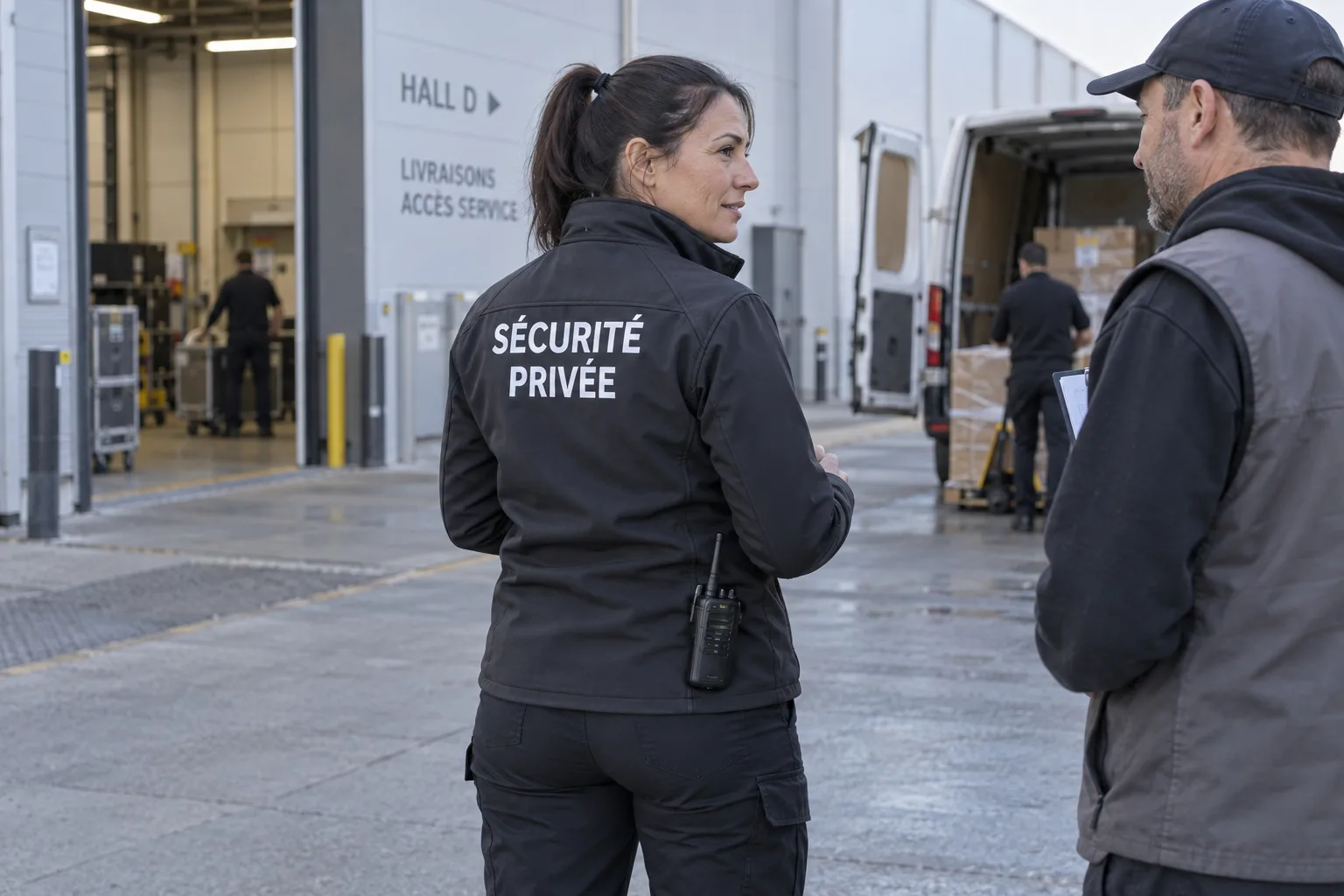
Workplace images are fictional AI illustrations created for Get Licensed. Country imagery reflects the referenced setting.
© 2026 Get Licenced LLC. All rights reserved. Source material retains its own rights.