
Germany · Sicherheitsmitarbeiter/in
The security worker handbook: Germany
Local legal foundations, safer shifts and preparation for section 34a.
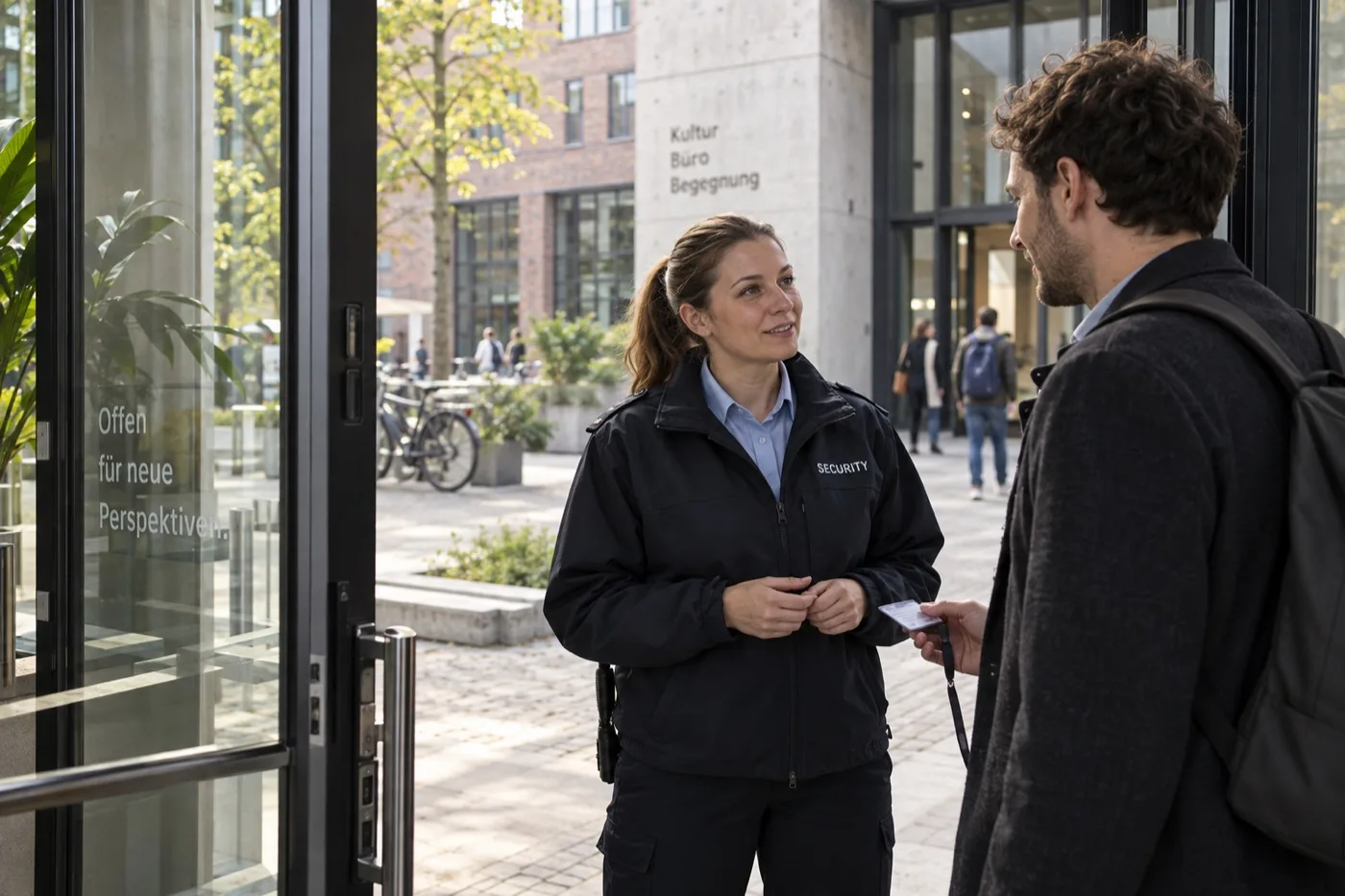
Handbook / 1.0
Edition scope
Independent Get Licensed learning handbook, published by Get Licenced LLC. It explains selected foundations for general guarding. Recognised qualifications, workplace instruction, oral assessment and individual legal advice have separate roles. This material has no claimed IHK or regulator approval. The official examination is in German. Sources checked 20 September 2026; consult them for later changes.
Germany. Federal law provides the foundation; competent authorities, local rules and specific assignments add requirements.
Competent trade authority and IHK chamberChapter 01
Your route into security work
The assignment, qualification and authority checks belong together.
First establish the duties you will carry out. Section 34a GewO distinguishes work that may be covered by IHK instruction or a recognised equivalent from activities requiring the competence examination. The latter include patrols in public traffic areas or privately controlled places with actual public access, preventing shoplifting, and guarding nightclub entrances. The law also specifies particular supervisory roles at refugee accommodation and large events with controlled access.
IHK instruction requires at least 40 teaching units of 45 minutes, German at B1 level or above, full attendance and demonstrated understanding. The chamber checks understanding during instruction. The Sachkundeprüfung is a separate written and oral assessment. A preparation course or online quiz alone confers no authority to start an assignment.
Before deployment, the employer and relevant authority must also address reliability, required evidence and registration. A job title rarely describes every requirement. Ask about the site, duties, shift and responsibility. The competent authority determines recognised exemptions and equivalent qualifications.
For the competence examination, the written part needs at least 60 of 120 points. The oral part must separately reach at least 50 per cent. Prepare for both and practise explaining legal reasoning in German.
- Obtain a written description of the duties.
- Check the qualification route with the employer and IHK.
- Confirm authority clearance before deployment.
Put it into practice
A new assignment
You have completed instruction and an employer offers you a store-detective assignment.
Raise the competence-examination requirement and confirm the necessary evidence before starting.
Why it mattersPreventing shoplifting is one of the activities expressly listed in section 34a.
Official sources: Bundesministerium der Justiz und Bundesamt für JustizBundesministerium der Justiz und Bundesamt für JustizIHK HannoverIHK Karlsruhe
Chapter 02
Your assignment and public authority
Your assignment establishes what you are responsible for.
Security workers protect people, assets and agreed operations through observation, hazard reporting, lawful access control and arranging assistance. Section 34a(5) GewO limits powers towards other people to rights available generally, contractually delegated self-help rights and any powers expressly granted by legislation. Necessity governs the use of those rights.
A uniform, staff identification or examination pass creates no general police power. Establish the site boundary, reporting line and relevant police contact. If an instruction is unclear, ask about its legal basis before carrying it out. A client cannot enlarge statutory powers through assignment instructions.
A useful working check asks what you personally observed, the specific danger involved, the lawful action needed, and who must decide or assist. Make observations and actions traceable in your report. Any exceptional statutory delegation must be established in the assignment.
- Clarify authority before the shift.
- Escalate uncertain jurisdiction to a supervisor.
- Record observations, decisions and actions.
Put it into practice
An unclear instruction
A client asks you to routinely confiscate identity documents on the street.
Ask for the legal basis and escalate the instruction to your manager.
Why it mattersA private assignment creates no general public-authority power to check and seize identity documents.
Official sources: Bundesministerium der Justiz und Bundesamt für JustizBundesministerium der Justiz und Bundesamt für Justiz
Chapter 03
Access, premises rights and consent
Access checks need clear rules and a respectful process.
The person entitled to control premises can set access rules within legal limits. A security worker acts within the delegated assignment. Check visitor lists, identification and permissions according to the site’s lawful arrangements. Explain a missing requirement calmly and offer the agreed way to resolve it.
For an ordinary private access check, inspecting a bag depends on the person’s voluntary cooperation. A sign or premises-rights assignment creates no general power to compel a search. If someone declines, refer the access decision through the lawful site procedure. Refusal alone creates no arrest power.
Access decisions must respect applicable discrimination rules. Section 19 AGG protects against discrimination on grounds including ethnic origin, sex, religion and disability in specified civil transactions. Apply lawful objective criteria consistently. Record the actual access requirement that was missing and who made the decision.
Before a voluntary check, establish its specific scope and consent. For a missing badge, use the designated alternative process; a familiar name or borrowed card cannot replace authorisation. Record authorised exceptions and hand over unresolved questions with checks completed and the responsible decision-maker. Where a premises ban is disputed, check its basis and scope.
- Read the assignment and site rules.
- Respect voluntary participation in a check.
- Record objective reasons for an access decision.
Put it into practice
An unregistered visitor
A visitor is absent from the list and declines a bag check.
Contact the responsible host and explain the agreed access process.
Why it mattersPremises rights, consent and other legal limits apply together.
Official sources: Bundesministerium der Justiz und Bundesamt für JustizBundesministerium der Justiz und Bundesamt für JustizBundesministerium der Justiz und Bundesamt für Justiz
Chapter 04
Arrest, self-defence and necessity
Understand the conditions before interfering with another person’s rights.
Section 127(1) StPO permits provisional arrest under limited conditions: a person is caught in the act or pursued immediately, with suspected flight or identity that cannot be established immediately. A rumour, assumption or uneasy feeling does not automatically meet those conditions. Reliable observations are central to the assessment.
Self-defence under section 32 StGB concerns necessary defence against a present unlawful attack on oneself or another person. Section 34 concerns a present danger that cannot otherwise be avoided and requires balancing the interests involved and an appropriate action. The provisions have different conditions. A finished dispute provides no authority for punishment by security staff.
Arrange assistance early when violence is possible and consider everyone’s safety. This chapter gives legal orientation. Physical interventions, safe application and operational decisions require suitable practical training, employer procedures and assessment of the actual circumstances. Notify police and promptly record the sequence and assistance given.
Under section 34, the protected interest must substantially outweigh the affected one; consider danger, alternatives and appropriateness. Following provisional arrest, further handling serves prompt transfer to competent authorities. Record first-hand facts, times and the reasons for your actions. Injured people need necessary and reasonable assistance even where they are suspected of wrongdoing.
- Separate observations from assumptions.
- Assess the present danger and legal basis.
- Request support and record events promptly.
Put it into practice
An uncertain suspicion
A colleague says someone resembles a person involved in an earlier incident.
Gather specific observations and contact the relevant authority when needed.
Why it mattersProvisional-arrest conditions must be established in the current circumstances.
Official sources: Bundesministerium der Justiz und Bundesamt für JustizBundesministerium der Justiz und Bundesamt für JustizBundesministerium der Justiz und Bundesamt für JustizBundesministerium der Justiz und Bundesamt für JustizBundesministerium der Justiz und Bundesamt für Justiz
Chapter 05
Personal information and camera footage
Handle information for a defined lawful purpose.
Visitor records, registration plates, incident reports and camera footage may contain personal data. The GDPR requires lawfulness, purpose limitation, minimisation, accuracy, limited retention and security. Collect only what is necessary for your assigned purpose. Follow the controller’s instructions and consult the privacy contact where uncertain.
Camera access carries responsibility. Use footage for the authorised task, protect login details and follow retention and export procedures. Taking a private phone photograph of a monitor or messaging a friend creates further processing that may be unlawful. Storage capacity does not establish an acceptable retention period.
Report a lost device, misdirected report or unauthorised access internally without delay. The controller assesses notification duties and further action. Route access and erasure requests through the designated process. Preserve investigation material under authorised instructions and log access.
People must receive the required processing information, including the controller and purpose. Before disclosure, check the recipient’s authority and record the lawful transfer. Use secure work channels and restrict access. Report a disclosure error immediately through the internal procedure so the responsible person can assess further action.
- Lock screens and protect credentials.
- Collect necessary information only.
- Report data incidents internally without delay.
Put it into practice
An interesting clip
A friend asks for camera footage of a celebrity visitor.
Decline the request and follow the authorised disclosure process.
Why it mattersCuriosity supplies no lawful processing purpose.
Official sources: European UnionDatenschutzkonferenz
Chapter 06
Communication and clear reports
Calm language helps gather information and contain conflict.
Introduce yourself and explain your purpose briefly. Listen, ask one question at a time and allow a response. A quieter setting, simple wording or suitable language assistance can improve understanding. Avoid assumptions about intentions based on appearance, origin, disability or language.
During conflict, use factual boundaries, manageable choices and early support. Keep emergency routes clear and maintain a safe distance in line with your training. Agree who leads the conversation. Threats, humiliation or a contest for authority can intensify the situation.
A useful report records time, place, specific observations, clearly attributed statements, actions and notifications. Separate what you saw from what others reported. Identify uncertainty and make corrections traceable. Share personal information with authorised recipients. Use the same structure in radio messages and shift handovers.
- Describe behaviour precisely.
- Attribute other people’s statements.
- Record the timing and content of key notifications.
Put it into practice
Conflicting accounts
Two visitors describe the same incident differently.
Record both accounts with their source, alongside your observations.
Why it mattersSeparating sources makes the report traceable.
Official sources: Bundesministerium der Justiz und Bundesamt für JustizBundesministerium der Justiz und Bundesamt für JustizEuropean Union
Chapter 07
Hazards, emergencies and first aid
Start with a safe, organised response.
Before duty, check site hazards, alarm routes, assembly points, escape routes and available equipment. Workers must take care of their own and others’ safety within their abilities and instruction. Immediate serious dangers and defects in protective systems must be reported promptly to the employer or responsible supervisor.
For an accident or immediate danger, alert the designated site contacts and emergency service. In Germany, 112 reaches fire and ambulance services; 110 reaches police emergencies. Give the location, event, evident hazards and people affected. Follow the dispatcher’s questions and instructions. Help within your ability and training without significant danger to yourself.
Section 323c StGB requires reasonable assistance under its conditions and prohibits obstructing people who help. Keep responder access clear and guide arriving crews. Firefighting, electrical equipment and medical actions each require suitable training and safe conditions. A learning question cannot replace practical instruction and first-aid training.
- Know alarm arrangements before duty.
- Report hazards and defects promptly.
- Keep escape routes and responder access clear.
Put it into practice
A defective exit
You find a blocked emergency exit on patrol.
Report it immediately and arrange safe action through the site procedure.
Why it mattersHazards and protective-system defects require prompt reporting.
Official sources: Bundesministerium der Justiz und Bundesamt für JustizBundesministerium der Justiz und Bundesamt für JustizBundesministerium der Justiz und Bundesamt für JustizBundesamt für Bevölkerungsschutz und KatastrophenhilfeBundesamt für Bevölkerungsschutz und Katastrophenhilfe
Chapter 08
Technology and equipment
Use authorised equipment for which you have received instruction.
Access systems, intrusion alarms, fire alarms and radios support the assignment. Understand what a signal means, the checks required and who may operate or reset equipment. An alert provides information that must be assessed through the agreed procedure. Never disable a protective function to conceal a fault.
At handover, check radios, batteries, keys, lighting and any personal protective equipment. Report missing or defective items. Lone working requires agreed check-in and alarm arrangements. Failed communications may require changing the assignment.
Armed roles carry additional legal requirements. Section 34a qualification creates no general weapons entitlement. Acquisition, carrying, storage and use require separate legal and employer assessment. This handbook provides no weapon-use techniques. Use equipment expressly authorised for your assignment.
Armed guarding has additional requirements. Section 28 WaffG links carrying to a specific qualifying assignment. Guards must be named to the authority, and transferring firearms or ammunition requires its agreement. Confirm authorisations and qualifications before accepting such duties. This chapter gives no firearms-handling instruction.
For radios, check power, the agreed channel and connection. A fault report identifies the device, exact place, time and observed defect. Camera views can be incomplete, so record their limits too. Export footage only for an authorised purpose through the designated procedure, with protected access.
- Record equipment checks.
- Report faults and arrange replacements.
- Obtain separate approval for specialist equipment.
Put it into practice
A radio cannot connect
Your radio cannot reach control before a lone patrol.
Report the fault and establish working communication and alarm arrangements before proceeding.
Why it mattersWork equipment and protective arrangements must suit the assignment.
Official sources: Bundesministerium der Justiz und Bundesamt für JustizBundesministerium der Justiz und Bundesamt für JustizBundesministerium der Justiz und Bundesamt für JustizBundesministerium der Justiz und Bundesamt für JustizBundesministerium der Justiz und Bundesamt für JustizBundesministerium der Justiz und Bundesamt für JustizEuropean UnionDatenschutzkonferenz
Chapter 09
Shift work and professional responsibility
Plan rest, handovers and continuing learning deliberately.
Schedules, actual working time and breaks should be traceable. The general rule in section 4 ArbZG gives at least 30 minutes of breaks for more than six and up to nine working hours, and 45 minutes for more than nine. Section 5 generally provides eleven consecutive hours of rest. Statutory exceptions and applicable collective agreements need checking for the assignment.
Raise fatigue, a missing relief worker or unclear hours with management early. Hand over keys, unresolved incidents, hazards and outstanding action in a structured way. Personal information belongs in designated work systems. Check your contract and any collective agreement for the workplace, pay, supplements and working-time arrangements.
Qualifications and continuing suitability are separate matters. The authority reviews reliability regularly, with section 34a specifying a review at least every five years. Duties, specialist qualifications and employer instruction can change. Keep evidence organised and report changes through the agreed process.
Section 4 permits breaks in segments of at least 15 minutes. Generally, work must not continue for more than six hours without a break. Planning must allow an actual interruption; clarify relief and availability expectations. Recording an untaken break afterwards does not fulfil that purpose.
- Keep reliable records of hours and breaks.
- Confirm relief and handover arrangements.
- Check changes in duties or required evidence.
Put it into practice
Missing relief
Your relief worker has not arrived and another shift would affect your rest.
Contact management, record the issue and arrange safe lawful cover.
Why it mattersWorking time, rest and safe staffing need to be organised together.
Official sources: Bundesministerium der Justiz und Bundesamt für JustizBundesministerium der Justiz und Bundesamt für JustizBundesministerium der Justiz und Bundesamt für JustizBundesministerium der Justiz und Bundesamt für Justiz
Chapter 10
Using the examination preparation
Practise knowledge, reasoning and clear answers in German.
Since 1 July 2025 the written Sachkundeprüfung has 82 questions, 120 minutes and 120 available points. Passing requires at least 60 points. Questions have one or two correct answers. Each correct selection earns a point; selecting more answers than there are correct choices gives zero for that question.
The oral part follows a passed written assessment and takes about 15 minutes per candidate. It also requires at least 50% of the available marks. Practise explaining a situation in your own words: observations, legal basis, limits, safe action and reporting. German is the examination language; the English handbook is a supporting study aid.
Get Licensed exercises use original authored questions. Their count, time and points follow the published format; our allocation between topics is editorial. They provide no promise of original examination questions, oral-assessment replication or complete syllabus coverage. After reviewing results, read the linked chapters and primary sources for weaker areas.
- Check the available points and multiple-answer instruction.
- Practise explanations aloud in German.
- Use IHK material and instruction to develop weaker topics.
Put it into practice
Managing the time
You become stuck on one question.
Flag it for review and work through the remaining questions first.
Why it mattersDeliberate time management helps you attempt the full written paper.
Official sources: IHK HannoverIHK ChemnitzIHK Karlsruhe
Your assessment route
Section 34a written-exam practice
82 original questions, 120 minutes and 120 points following the published written format. Topic allocation is editorially set by Get Licensed and does not represent a verified IHK topic weighting.
The written threshold is 60 of 120 points. Each correct selection earns one point. Selecting more answers than there are correct answers makes the whole item score zero. On a two-point item, one correct and one wrong selection earns one point; selecting both correct answers earns two.
Other training and assessment requirements
The separate oral part also requires at least 50 per cent and lasts approximately 15 minutes per candidate. This quiz cannot replace that assessment or checks of personal and authority requirements. The IHK examination is in German.
Test your knowledgeBefore your shift
- Read the assignment, boundaries and current instructions.
- Check your qualification and clearance for the duties.
- Check radios, alert devices and safe check-ins.
- Know escape routes, first-aid equipment and emergency access.
- Take over unresolved events from the previous shift.
- Explain and apply access rules consistently.
- Record facts, actions and notifications promptly.
- Confirm breaks and relief arrangements.
- Transfer information, keys and access devices securely.
Fire and ambulance
Give the location, event and visible hazards. Follow the operator’s questions and the site’s additional alert arrangements.
Words you will use
- Sicherheitsmitarbeiter/in
- A common German job title for a security worker; actual duties determine requirements.
- Unterrichtung
- IHK instruction with at least 40 teaching units, attendance and checked understanding.
- Sachkundeprüfung
- Written and oral IHK competence examination for duties listed in section 34a.
- Zuverlässigkeit
- Reliability assessed by the authority as a personal requirement for guarding.
- Hausrecht
- Control over access to and use of premises, subject to legal limits.
- Notwehr
- Necessary defence against a present unlawful attack under section 32 StGB.
- Rechtfertigender Notstand
- Justification subject to danger, balancing and appropriateness under section 34 StGB.
- Vorläufige Festnahme
- Provisional arrest subject to section 127 StPO.
- Dienstanweisung
- Assignment instructions describing duties, procedures and reporting within the law.
- Leitstelle
- Control room coordinating responses, alarms and information.
- Datenminimierung
- Limiting personal data to what is necessary for the purpose.
- Ruhepause
- A scheduled interruption to work under applicable working-time rules.
Official sources
Sources checked: 2026-09-20 · Next source review: 2026-12-20
- Gewerbeordnung § 34a
Bundesministerium der Justiz und Bundesamt für Justiz · 2026-09-20
- Bewachungsverordnung § 6
Bundesministerium der Justiz und Bundesamt für Justiz · 2026-09-20
- Sachkundeprüfung Bewachungsgewerbe
IHK Hannover · 2026-09-20 · 82 questions and 120 points since 1 July 2025; one point per correct selection, over-selection scores zero.
- Neue Bewertungsregeln in der Sachkundeprüfung Bewachungsgewerbe
IHK Chemnitz · 2026-09-20
- Prüfungsordnung für die Sachkundeprüfung im Bewachungsgewerbe
IHK Karlsruhe · 2026-09-20
- Bewachungsverordnung, Anlage 2
Bundesministerium der Justiz und Bundesamt für Justiz · 2026-09-20
- Bürgerliches Gesetzbuch § 903
Bundesministerium der Justiz und Bundesamt für Justiz · 2026-09-20
- Strafprozessordnung § 127
Bundesministerium der Justiz und Bundesamt für Justiz · 2026-09-20
- Strafgesetzbuch § 32
Bundesministerium der Justiz und Bundesamt für Justiz · 2026-09-20
- Strafgesetzbuch § 34
Bundesministerium der Justiz und Bundesamt für Justiz · 2026-09-20
- Allgemeines Gleichbehandlungsgesetz § 19
Bundesministerium der Justiz und Bundesamt für Justiz · 2026-09-20
- General Data Protection Regulation, Articles 5, 6, 13, 29 and 32
European Union · 2026-09-20
- Orientierungshilfe Videoüberwachung durch nicht-öffentliche Stellen
Datenschutzkonferenz · 2026-09-20
- Arbeitsschutzgesetz § 15
Bundesministerium der Justiz und Bundesamt für Justiz · 2026-09-20
- Arbeitsschutzgesetz § 16
Bundesministerium der Justiz und Bundesamt für Justiz · 2026-09-20
- Strafgesetzbuch § 323c
Bundesministerium der Justiz und Bundesamt für Justiz · 2026-09-20
- Arbeitszeitgesetz § 4
Bundesministerium der Justiz und Bundesamt für Justiz · 2026-09-20
- Arbeitszeitgesetz § 5
Bundesministerium der Justiz und Bundesamt für Justiz · 2026-09-20
- Merkblatt zur Sachkundeprüfung, Bewertungsregeln ab 1. Juli 2025
IHK Hannover · 2026-09-20
- Waffengesetz § 28
Bundesministerium der Justiz und Bundesamt für Justiz · 2026-09-20
- Erste Hilfe und Notruf
Bundesamt für Bevölkerungsschutz und Katastrophenhilfe · 2026-09-20
Workplace images are fictional AI illustrations created for Get Licensed. Country imagery reflects the referenced setting.
© 2026 Get Licenced LLC. All rights reserved. Source material retains its own rights.