
Florida · Class D security officer
Florida security worker handbook
Your licence route, legal boundaries and decisions on shift
Handbook / 2026.09.20
Edition scope
An independent preparation handbook published by Get Licenced LLC. It summarises selected rules and workplace decisions checked on the date shown. Your approved course, regulator and employer provide the requirements for your role. This handbook and its practice results do not award a licence or authorise physical intervention. Specialist roles, weapons, healthcare and site-specific rules require additional instruction.
For entry-level unarmed security work in Florida.
Florida FDACSChapter 01
Your Class D route
Check the school, instruction and application before you book.
Florida FDACS licenses security officers through the Class D route, subject to statutory exemptions. The ordinary applicant must be at least 18 and meet eligibility and screening requirements. The training requirement is at least 40 hours through a licensed school or training facility. Keep the official completion certificate for the application.
Authorised online instruction is live and includes identity, attendance and security controls. A collection of recorded videos and practice questions does not itself satisfy that requirement. The 2024 rule clarification says Class DI instructors teach online courses from a physical location in Florida. Ask the school about its licence, timetable, assessment and certificate process before committing.
- Verify the Class DS school and the relevant instructor.
- Budget for the course, application and required screening.
- Confirm the date your licence and work authority allow you to begin.
Put it into practice
An instant certificate offer
A website offers a Class D certificate after a short recorded lesson.
Check the provider against FDACS and ask how the full required instruction is delivered.
Why it mattersThe statutory route requires the licensed training process and successful completion.
Official sources: Florida FDACSFlorida LegislatureFlorida Department of State
Chapter 02
Legal powers and their limits
Understand the legal basis before you restrict another person.
A Class D licence supports regulated private-security employment. Misrepresenting yourself as a law-enforcement officer is a disciplinary issue under section 493.6118. A client’s request or a uniform cannot expand statutory authority. Be clear about your identity and assignment when speaking to the public.
Retail detention has specific conditions under section 812.015, including the relevant role, grounds and reasonable manner and duration. Police must be called immediately after custody in the circumstances identified by the statute. Section 493.631 creates a separate, restricted critical-infrastructure rule with both Class D or MB and Class G requirements. An unarmed Class D worker should obtain role-specific legal instruction and call police when authority is uncertain.
- Treat admission checks, detention and arrest as different decisions.
- Seek police assistance and preserve observations when unsure.
- Follow lawful employer procedures and record the basis for action.
Put it into practice
An ordinary office and a detention request
A manager quotes the critical-infrastructure rule to an unarmed office guard.
Escalate the request and seek the applicable legal basis for this post.
Why it mattersSection 493.631 has defined facility and licence conditions.
Official sources: Florida LegislatureFlorida LegislatureFlorida Legislature
Chapter 03
Professional conduct and communication
A reliable officer is clear, consistent and ready to help.
Arrive fit for duty, understand the assignment and identify the supervisor who can resolve uncertainty. A report of fatigue or a broken radio gives the employer a chance to arrange cover or equipment. Accept gifts, outside work or changes of duty only through the employer’s policy, especially when they could influence an access decision.
Use respectful language and describe observable conduct. In a disagreement, explain the rule, listen to the concern and offer the authorised next step. Customer service, cultural awareness and public relations are part of the Florida curriculum. A visitor with a disability may need a different communication method while receiving the same lawful service.
- Keep personal arguments out of the interaction.
- Ask a supervisor to resolve conflicting instructions.
- Record and report harassment or threats through the workplace process.
Put it into practice
A familiar contractor without clearance
A contractor offers a gift and asks you to skip the sign-in process.
Decline the shortcut and follow the authorised access process.
Why it mattersConsistent decisions protect the site and the integrity of the officer’s role.
Official sources: Florida FDACSFlorida LegislatureUS Department of Justice
Chapter 04
Access, patrol and physical security
Turn post orders into a repeatable shift routine.
Know which doors, keys, badges and deliveries you are responsible for. Verify requests through the approved channel and record exceptions. When routine screening relies on consent, explain it and pause if permission is withdrawn. Ask the supervisor how refusal is handled; a site rule alone supplies no general authority for a forced search.
Patrol with attention to changes: a damaged lock, an obstructed exit, a spill, a door left open or an unexpected person in a restricted area. Report the exact location and immediate risk. Follow the emergency plan for urgent hazards and the maintenance route for defects. Protect access credentials and tell the next shift what remains unresolved.
- Check keys, radio and required safety equipment at handover.
- Record meaningful patrol observations and unresolved defects.
- Keep evacuation routes clear during access and crowd management.
Put it into practice
A delivery blocks an exit
A courier leaves cartons across the marked exit route.
Arrange safe clearance through the site process and report the obstruction.
Why it mattersSecurity controls and commercial activity must preserve safe escape routes.
Official sources: Florida FDACSUS OSHA
Chapter 05
Observation, reports and evidence
Separate what happened from what you think it means.
Observe from a safe position and write down time, location, actions and identifying details relevant to the event. Separate your own observations from information given by witnesses. A witness interview should use clear, open questions without promises, coaching or pressure. Preserve the speaker’s meaning and record uncertainty.
Use the approved incident form and evidence process. Keep original notes, preserve relevant camera footage and record handovers. Avoid altering files or moving items unnecessarily. Section 493.6119 restricts unauthorised disclosure and false reports. An honest limitation in your account is more useful than a confident invented detail.
- Record estimates as estimates.
- Store records in authorised systems.
- Give police factual information and identify its source.
Put it into practice
Two witnesses disagree
Two people give different times for the same event.
Record each account separately and note any supporting time source.
Why it mattersA report preserves evidence for evaluation; it should not manufacture agreement.
Official sources: Florida FDACSFlorida Legislature
Chapter 06
Handle information with care
Access records for the task you have been assigned.
Visitor logs, licence details, CCTV, incident records and access codes can expose people or the site when shared carelessly. Keep screens and paperwork away from public view, verify the authority of a requester and use the approved disclosure route. Report lost equipment, misdirected messages or unauthorised access promptly so the organisation can respond.
Healthcare assignments can involve protected health information and HIPAA requirements that depend on the organisation and the role. Follow the site’s access rules and training. Access should reflect the work needed, and many disclosures are subject to a minimum-necessary standard with legal exceptions. Refer unusual requests to the designated privacy or management contact.
- Use your own authorised login and secure the workstation when leaving.
- Keep credentials personal and share footage or records only through authorised procedures.
- Ask the designated owner about retention, lawful disclosure and deletion.
Put it into practice
A friend asks about a patient
A friend asks whether someone has been admitted to the hospital where you work.
Use the hospital’s authorised enquiry route and preserve confidentiality.
Why it mattersEmployment access does not authorise a personal disclosure.
Official sources: Florida LegislatureFlorida LegislatureUS Department of Health and Human Services
Chapter 07
Emergencies, fire and severe weather
Use the site plan and give responders useful information.
Know how to raise an alarm, call 911, direct responders and account for people. Your employer’s emergency plan should identify evacuation, shelter and communication arrangements. During an incident, report the exact location, known hazards and assistance needed. Keep yourself out of smoke, unknown chemicals and other hazardous areas.
Florida sites should brief severe-weather and flood arrangements. Follow evacuation instructions and avoid floodwater; roads, electrical hazards and depth may be hidden. An unattended object requires a calm assessment of context. A suspected hazardous item should be left alone, reported and managed through the site plan and emergency services.
- Keep exits and responder access routes clear.
- Distinguish a routine defect from immediate danger.
- Follow the designated incident command and handover process.
Put it into practice
The car park floods
Water covers the usual vehicle exit after intense rainfall.
Keep people away from the flooded route, report it and use the approved safe alternative.
Why it mattersWater can conceal electrical, depth and surface hazards.
Official sources: US OSHAUS FEMA Ready.govUS CISA
Chapter 08
Medical help and personal safety
Recognise urgent need, call for help and act within your training.
Check scene safety before approaching a casualty. Activate emergency medical help for life-threatening conditions and ask someone to retrieve the site’s emergency equipment. Follow the dispatcher, your current first-aid training and the AED’s instructions where appropriate. Keep access clear for responders and report changes in the person’s condition.
Use appropriate protective equipment where blood or body-fluid exposure is possible. If an occupational exposure occurs, report it promptly for the employer’s medical evaluation process. Avoid unnecessary movement of a person with a possible head, neck or spinal injury. During a seizure, protect the person from nearby hazards, time the event and follow current first-aid guidance without restraining them.
- Get consent from a responsive person before care where possible.
- Keep the person’s information private.
- Provide an accurate handover of observations and assistance already given.
Put it into practice
A collapse by reception
A visitor collapses near a busy entrance.
Check safety, call 911, send for available emergency equipment and follow current training and dispatcher instructions.
Why it mattersRapid help and a clear responder route support the person until specialist care arrives.
Official sources: American Red CrossAmerican Red CrossAmerican Heart Association and American Red CrossUS OSHA
Chapter 09
Special assignments and respectful risk assessment
Every site adds its own instructions and training needs.
Events, healthcare, transport, industrial sites and retail work can add different access rules and emergency roles. Receive a briefing on crowd routes, vulnerable people, child safeguarding, lost property and whom to call. If a duty requires specialist equipment or a separate licence, have the employer verify your authorisation and competence first.
Threat awareness starts with observed behaviour and context. Report a credible threat, attempted unauthorised access or a concerning item with factual details. Race, religion, national origin and disability do not establish suspicious activity. Maintain distance from immediate danger and let police assess potential criminal activity. A general unarmed preparation course supplies no weapons qualification.
- Ask about the specific post before accepting a new task.
- Use accessible communication and protect confidential details.
- Record behaviour accurately and avoid assumptions about identity.
Put it into practice
Photography at a public entrance
A visitor photographs the building from a public area.
Consider the context and site policy; report specific concerning behaviour if present.
Why it mattersPhotography and appearance alone do not prove hostile intent.
Official sources: Florida FDACSUS Department of Homeland SecurityUS Department of Justice
Chapter 10
Practise the published Class D format
Use the topic breakdown to plan your revision.
The FDACS curriculum specifies 170 questions across 18 subject areas and at least two hours of testing, which a school may administer throughout or after instruction. The published rule sets 128 correct answers as the passing requirement. The rehearsal here has 170 original questions using the curriculum’s topic counts and a 120-minute practice session.
The two-hour setting is a rehearsal choice based on the official minimum total testing time. Your school determines the actual permitted testing arrangements. Review incorrect answers and revisit the cited material, then complete the licensed course and its assessment. Passing this independent mock provides no FDACS certificate or licence.
- Use practice mode for explanations and the full rehearsal for sustained recall.
- Aim beyond the pass threshold and revise uncertainty.
- Confirm the real school’s rules before exam day.
Put it into practice
A score of 127
A learner answers 127 of the 170 rehearsal items correctly.
Review the missed topics and try again after studying.
Why it mattersThe published threshold is 128 correct answers.
Official sources: Florida FDACSFlorida Department of StateFlorida Administrative Register
Your assessment route
Florida Class D format practice
170 original multiple-choice questions using all 18 question totals in the FDACS curriculum. The practice timer is 120 minutes. The official guide says testing takes not less than two hours and may occur throughout or on completion of instruction; 120 minutes is not presented as an official maximum.
Rule 5N-1.140 specifies at least 128 correct answers. This practice awards one point per question and uses 128/170. The curriculum publishes the topic counts; our questions are original and do not reproduce the official test.
Other training and assessment requirements
The Class D route requires the licensed 40-hour course and its instructor-administered assessment. Online instruction has live teaching, identity and attendance controls. Confirm the current course arrangements with the licensed school. Independent practice does not issue the training certificate or licence.
Test your knowledgeBefore your shift
- Confirm the licence and training conditions for this assignment.
- Read the post orders and identify any specialist duties requiring additional instruction.
- Check communications and the agreed fallback.
- Know the emergency address, entrances, alarm process and assembly arrangements.
- Confirm authorised visitor checks and the process for uncertain authority.
- Identify first-aid equipment and trained assistance.
- Keep logs and personal information secure, with a factual incident-reporting process.
- Hand over faults, evidence and unfinished actions through the approved record.
Police, fire or medical emergency
Give the exact address, entrance, immediate danger and callback number. Follow dispatcher instructions.
Words you will use
- FDACS
- Florida Department of Agriculture and Consumer Services, which administers private-security licensing.
- Class D
- The Florida security officer licence category for the regulated role, subject to its conditions.
- Class DS
- The security officer school or training-facility licence category.
- Class DI
- The security officer instructor licence category.
- Class G
- The statewide firearms licence category, with separate conditions and training; Class D alone does not authorise armed duties.
- Retail detention
- A limited statutory route under section 812.015, requiring the relevant grounds, role and reasonable manner and time.
- Post orders
- The lawful instructions and responsibilities for the particular assignment.
- Chain of custody
- The documented sequence of authorised possession and transfer of evidence.
- Standard precautions
- Workplace measures that reduce exposure to blood or other potentially infectious material.
- Minimum necessary
- A HIPAA concept limiting certain uses and disclosures of protected health information; its application depends on the organisation and circumstances.
- Incident report
- A factual account of observations, supplied information, actions and notifications.
- Class D format practice
- Our independently authored 170-question revision attempt, using the regulator’s published topic counts.
Official sources
Sources checked: 2026-09-20 · Next source review: 2026-12-20
- Service animals and the ADA
US Department of Justice · 2026-09-20
- Service animal questions and limits
US Department of Justice · 2026-09-20
- Suspicious or unattended item guidance
US CISA · 2026-09-20
- Recognising suspicious activity
US Department of Homeland Security · 2026-09-20
- 2024 first aid guidelines
American Heart Association and American Red Cross · 2026-09-20
- Florida Statutes section 493.6118, conduct and discipline
Florida Legislature · 2026-09-20
- Florida Statutes section 493.6119, information and reports
Florida Legislature · 2026-09-20
- Florida Statutes section 493.631, critical-infrastructure detention
Florida Legislature · 2026-09-20
- Security Officer Training Curriculum Guide
Florida FDACS · 2026-09-20 · Revision 11/2018 remains linked by current Rule 5N-1.140; page 8 publishes the 170-question topic distribution.
- 2024 online-instruction clarification
Florida Department of State · 2026-09-20 · DI instructors teach online courses from a physical location in Florida.
- Rule text publishing the 128-correct requirement
Florida Administrative Register · 2026-09-20 · Rule 5N-1.140(1)(c), page 4; read with subsequent final-adoption history and 2024 clarification.
- Florida Statutes section 812.015
Florida Legislature · 2026-09-20
- Class D licence requirements
Florida FDACS · 2026-09-20
- Rule 5N-1.140 history and current adoption
Florida Department of State · 2026-09-20 · Current adopted version effective 2024-11-28.
- Florida Statutes section 493.6303, training
Florida Legislature · 2026-09-20
- Flood safety
US FEMA Ready.gov · 2026-09-20
- HIPAA minimum necessary requirement
US Department of Health and Human Services · 2026-09-20
- Bloodborne pathogen exposure incidents
US OSHA · 2026-09-20
- Emergency action plans
US OSHA · 2026-09-20
- First aid response steps
American Red Cross · 2026-09-20
- Seizure first aid
American Red Cross · 2026-09-20
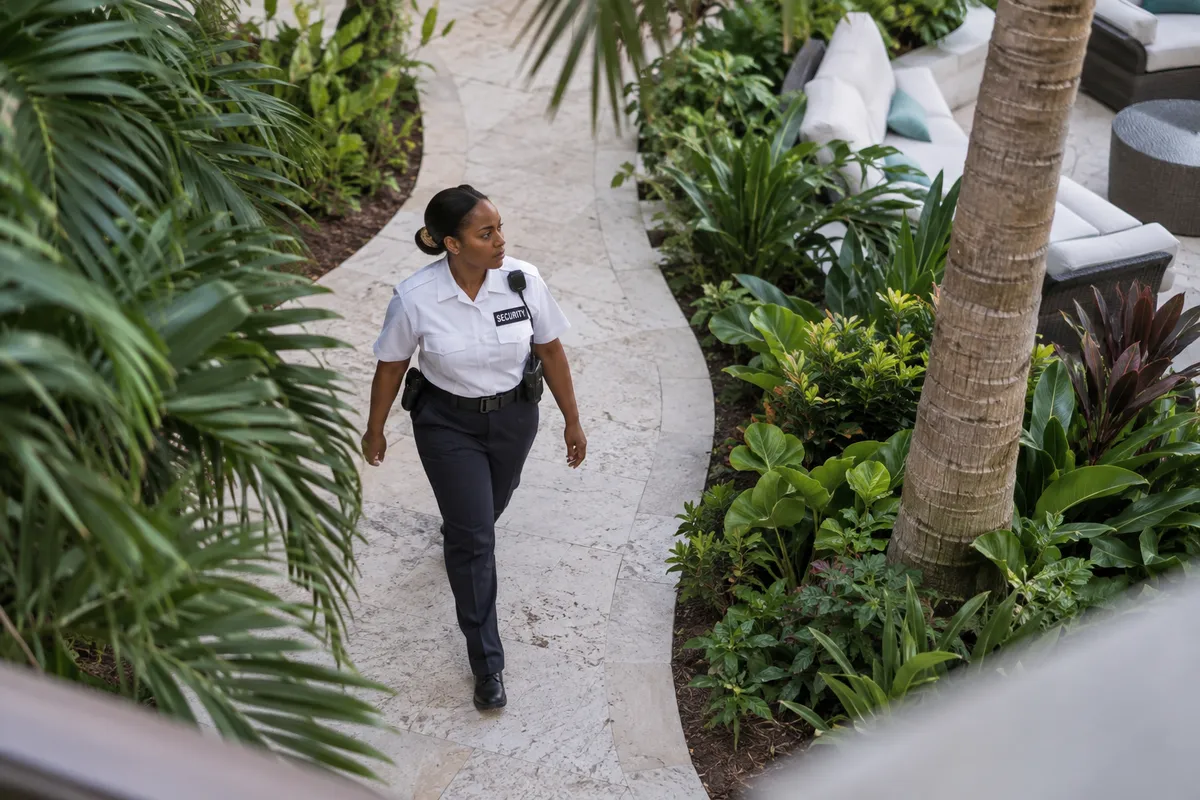
Workplace images are fictional AI illustrations created for Get Licensed. Country imagery reflects the referenced setting.
© 2026 Get Licenced LLC. All rights reserved. Source material retains its own rights.