
British Columbia · security guard
The security worker handbook: British Columbia
Understand your role, local rules and everyday decisions.
Handbook / 1.0
Edition scope
Independent preparation for general unarmed guarding. This edition covers selected rules and educational scenarios. Specialist tasks, recognised training, practical first aid and legal advice require their respective routes. Sources checked 20 September 2026; use the linked authorities for later changes.
British Columbia, Canada.
British Columbia Security Programs DivisionChapter 01
Your British Columbia licence route
Match your training and application to the right licence category.
The standard security guard route requires a BC security worker licence, usually from age 19, with residence, work-entitlement, screening and training requirements. A licence from another province requires the BC application route; check any recognition provisions.
The full guard route uses JIBC BST or another accepted qualification. For training completed after 15 December 2025, the province verifies completion with JIBC. Read every licence condition, carry the licence, show it on request as required by section 8 and track renewal. Report address changes, criminal charges and convictions within 14 days under section 9.
The regulation sets an ordinary maximum licence term of three years; check the actual expiry and any supervised-category limit. Handcuffs and security dogs require their own authorisations and accepted training. The province specifies Advanced Security Training renewal every three years and canine validation annually for those routes. General BST preparation does not teach these specialist techniques.
- Choose the full or supervised route consciously.
- Keep personal details and licence status current.
- Verify separate authorisations for specialist equipment.
Put it into practice
On shift
You finish BST and receive a job offer in Vancouver.
Complete the licensing process and confirm the issued licence covers the assignment.
Why it mattersA training result and an employer offer do not replace the worker licence.
Official sources: British Columbia LawsBritish Columbia Security Programs DivisionBritish Columbia Security Programs DivisionBritish Columbia Security Programs DivisionBritish Columbia Laws
Chapter 02
Prepare for the BC BST assessment
Build understanding and practise the published time limit.
JIBC publishes 75 questions, 90 minutes and a 70% minimum for SCRT-1656. The theory course is 40 hours. Students must pass the assessment within six months of theory completion; after two unsuccessful attempts, the theory course must be repeated.
Our original questions use an authored study allocation. They do not reproduce official items or claim official topic weights. JIBC currently requires Lower Mainland candidates to attend the New Westminster campus; its online-proctored option is for learners outside that area. Confirm booking requirements directly.
- Use explanations to identify the relevant rule.
- Practise at a steady pace and revisit uncertain items.
- Read current identification and device instructions before attending.
Put it into practice
On shift
You have completed a timed practice attempt but struggled with privacy questions.
Read the privacy chapter and its sources before repeating practice.
Why it mattersTargeted revision improves understanding beyond remembering an answer position.
Official sources: Justice Institute of British ColumbiaBritish Columbia Security Programs Division
Chapter 03
Your role and its boundaries
Protect people, prevent incidents and arrange the right help.
Your assignment is shaped by the site, your licence and authorised instructions. Observe risks, assist the public and communicate useful information. An employer instruction must fit the law that applies to the task.
Before accepting a post, identify the responsible supervisor, permitted areas and tasks requiring extra training. Ask for clarification when an instruction exceeds your training or authority.
BC’s regulation lets the registrar impose a code of conduct as a licence condition. Read the conditions on your licence together with the general laws that apply to everyone. The conduct examples here support professional decision-making.
- Check the assignment and licence validity.
- Know the supervisor and escalation contacts.
- Describe your role clearly to the public.
Put it into practice
On shift
A client asks you to investigate a visitor’s private life after your shift.
Refer the request to your manager and verify the necessary authority before collecting information.
Why it mattersA commercial request does not create additional legal powers.
Official sources: British Columbia LawsBritish Columbia Laws
Chapter 04
Access, consent and fair treatment
Apply entry rules calmly and consistently.
Check access against the site’s authorised criteria. Explain a screening request in a way the person can understand. Avoid assumptions based on appearance, ethnicity or background.
A person may decline voluntary screening. Follow the admission procedure and seek assistance. An entry rule does not itself authorise a forced bodily search or automatic detention.
Section 8 of the BC Human Rights Code addresses services customarily available to the public. Apply access criteria consistently and raise accommodation needs with the responsible person. Assess the facts and any applicable exception before deciding how an entry rule applies.
- Explain the reason for a check.
- Respect privacy and accessibility needs.
- Separate refused entry, suspicion and an observed offence.
Put it into practice
On shift
A visitor declines a bag check at an entrance with a stated screening policy.
Explain the available admission options and ask the supervisor to help if necessary. Avoid a forced search.
Why it mattersConsent and legal authority require separate consideration.
Official sources: British Columbia LawsBritish Columbia LawsDepartment of Justice Canada
Chapter 05
Citizen’s arrest and safety
Recognise legal thresholds and involve the police.
Section 494 of the Criminal Code sets limited circumstances for arrest by a private person. A guard licence does not give general police powers. Property-owner authority and what was actually observed can matter.
An intervention can cause injury and personal liability. Contact police as soon as possible, follow your training and hand a person lawfully arrested to a peace officer without delay. This chapter contains no restraint techniques.
- Suspicion alone does not establish every legal condition.
- Record observations and reasons for decisions.
- Leave investigative questioning and searches to police.
Put it into practice
On shift
A colleague says they recognise someone from a theft several weeks ago.
Collect the available facts and seek police assistance; avoid improvising an arrest.
Why it mattersThe conditions in section 494 must be satisfied and the risks assessed.
Official sources: Department of Justice CanadaDepartment of Justice Canada
Chapter 06
Communication and de-escalation
Reduce tension and deliver a useful message.
Effective communication begins with listening. Introduce yourself, explain the issue and offer a realistic next step. Keep a safe distance and preserve a route to leave.
On the radio, use agreed call signs and state the location, situation and assistance needed. Confirm important messages. Keep sensitive details on authorised channels and describe observable behaviour.
- Speak clearly, with one person leading.
- Adapt your pace to the person’s needs.
- Request support before the situation becomes unmanageable.
Put it into practice
On shift
A visitor raises their voice because they do not understand why a badge is rejected.
Listen, explain what you can check and offer to verify the badge with reception.
Why it mattersA calm voice and a concrete next step can support a safe resolution.
Official sources: British Columbia LawsBritish Columbia Laws
Chapter 07
Notes, reports and evidence care
Build a useful and accurate record.
Record the time, place, people involved, observations and actions promptly. Separate what you saw from what a witness told you. State uncertainty when a detail cannot be verified.
Keep notes and files in authorised systems. Make corrections transparently without hiding the original record. Minimise unnecessary handling of objects and record relevant transfers so their history can be traced.
Section 7 of the Security Services Regulation includes use-of-force records that a security business must maintain. Report any relevant intervention through the employer’s process and preserve an accurate account of what happened. The existence of a record does not establish that an intervention was lawful.
- Describe observable facts.
- Attribute witness statements clearly.
- Protect records containing personal information.
Put it into practice
On shift
A witness gives a different incident time from your watch.
Record both times with their sources and check available records.
Why it mattersThe discrepancy may matter; an accurate report preserves it.
Official sources: British Columbia LawsOffice of the Privacy Commissioner of Canada
Chapter 08
Privacy, cameras and personal information
Use information for an authorised purpose.
Images and records that identify a person require protection. Access only information needed for the assignment. Viewing, copying and disclosure must follow the responsible organisation’s procedure.
Visible surveillance of the public, employee monitoring and covert investigation have different rules. Direct requests for footage to the designated decision-maker and report accidental disclosure promptly.
- Keep workplace footage off personal social accounts.
- Verify the recipient before sending a file.
- Follow approved retention and deletion arrangements.
Put it into practice
On shift
A friend asks for a CCTV screenshot of an argument that has gone viral.
Decline personal sharing and route any official request through the authorised process.
Why it mattersCuriosity does not establish an authorised business purpose.
Official sources: Office of the Privacy Commissioner of CanadaBritish Columbia Laws
Chapter 09
Emergencies, alarms and first aid
Prepare the first few minutes before an incident happens.
At handover, locate exits, assembly points, alarm controls and first-aid resources. Clarify your place in the site plan, including receiving responders and helping people who need assistance.
When danger arises, protect yourself, call 911 where emergency help is needed and provide the exact location. Use your first-aid training and follow the dispatcher’s instructions. Reading alone does not establish practical competence.
- Know the access route for emergency services.
- Keep evacuation routes clear.
- Report missing people without entering an unsafe area.
Put it into practice
On shift
An alarm sounds and a visitor asks to return for a laptop.
Apply the evacuation plan and direct them to the agreed safe location.
Why it mattersProtecting people guides emergency decisions.
Official sources: WorkSafeBCJustice Institute of British Columbia
Chapter 10
Safe work and professional development
Look after your health and maintain your skills.
Security work can involve isolation, prolonged standing and distressing incidents. Check communication arrangements, rest opportunities and post-incident support. Report damaged equipment and hazards.
Keep your hours and pay records. Use the relevant authority for employment standards and unsafe-work procedures. Track licence renewal, first-aid currency and specialist permissions separately.
WorkSafeBC’s unsafe-work process begins by stopping the unsafe task and immediately reporting it to the supervisor or employer. If the concern remains after the initial investigation, the next investigation includes an eligible worker representative. If it remains unresolved after those steps, the worker and supervisor or employer must contact WorkSafeBC. Check the current procedure and the conditions that apply to the situation.
For isolated work or a foreseeable violence risk, learn the assessed hazards, contact arrangements and assistance procedure before starting. A welfare check needs a clear person responsible, timing and response when contact is missed. Use the site’s risk assessment and WorkSafeBC guidance to confirm the arrangements.
- Agree welfare checks for isolated work.
- Record training and expiry dates.
- Request a debrief after a difficult incident.
Put it into practice
On shift
Your radio fails before a patrol on an isolated site.
Report the fault and agree a safe communication arrangement before continuing.
Why it mattersLosing a protective measure changes the risk.
Official sources: WorkSafeBCBritish Columbia LawsWorkSafeBCWorkSafeBC
Your assessment route
BC BST timed practice
75 original questions, 90 minutes. The topic allocation is an authored study design; JIBC’s official item weighting is not reproduced.
JIBC publishes 70%. This independent activity applies an exact 70% practice benchmark. It does not predict or award an official exam result.
Other training and assessment requirements
Complete the recognised BST route and the official JIBC assessment. Separate authorisations require their own training.
Test your knowledgeBefore your shift
- Check the licence, its conditions and the assignment.
- Read post orders and outstanding handover matters.
- Test the radio and know support contacts.
- Locate exits, emergency access and first-aid resources.
- Confirm lone-work and accessibility arrangements.
- Use authorised systems for reports and information.
- Report hazards, incidents and damaged equipment.
- Give a factual and complete handover.
Emergency assistance
Give the exact location, danger and assistance needed. Follow the dispatcher’s instructions.
Words you will use
- Security guard
- A person carrying out protective duties within their licence and assignment.
- Post orders
- Site instructions that must fit the applicable law.
- Consent
- An informed and voluntary agreement in the relevant context, subject to applicable law.
- Personal information
- Information about an identifiable individual.
- Peace officer
- A legal category with powers and duties defined by law; a private licence does not itself confer that status.
- Continuity of evidence
- A documented history of possession and transfer of an item or record.
- De-escalation
- Actions intended to reduce tension and support a safe outcome.
- Accommodation
- An adjustment for a protected need, assessed in its legal context.
Official sources
Sources checked: 2026-09-20 · Next source review: 2026-12-20
- Security Services Act, sections 2, 3, 5, 8 and 9
British Columbia Laws · 2026-09-20 · Act displayed current to 2026-09-15. Sections 2, 3, 5, 8 and 9 cover licence scope, eligibility, conditions, carrying/production and reporting obligations.
- OHS guidelines, Part 4: working alone and violence
WorkSafeBC · 2026-09-20 · Site risk assessment, check-in systems and violence prevention; guidance applies with the OHS Regulation.
- Application and licence management
British Columbia Security Programs Division · 2026-09-20 · Checked public source on 2026-09-20; follow the linked authority for later changes.
- Basic Security Training and assessment
Justice Institute of British Columbia · 2026-09-20 · Official JIBC course and assessment information: 40-hour theory; 75 questions, 90 minutes and a 70% minimum. A six-month assessment window and two-attempt rule are published. Official topic weighting was not located.
- Human Rights Code, sections 8 and 13
British Columbia Laws · 2026-09-20 · Act displayed current to 2026-09-15. Sections 8 and 13 address services and employment; accommodation and exceptions require contextual assessment.
- British Columbia security worker licence
British Columbia Security Programs Division · 2026-09-20 · Checked public source on 2026-09-20; follow the linked authority for later changes.
- WorkSafeBC: refusing unsafe work
WorkSafeBC · 2026-09-20 · WorkSafeBC explains the staged process under OHS Regulation section 3.12, beginning with stopping and reporting the unsafe task.
- Security Services Regulation, sections 6, 7, 11, 12 and 14
British Columbia Laws · 2026-09-20 · Consolidation displayed current to 2026-04-07; last amendment 2025-05-01. The registrar may impose the code of conduct as a licence condition. Check the individual licence and subsequent changes.
- WorkSafeBC: worker rights and responsibilities
WorkSafeBC · 2026-09-20 · Checked public source on 2026-09-20; follow the linked authority for later changes.
- British Columbia security worker training requirements
British Columbia Security Programs Division · 2026-09-20 · Page updated 2026-04-21. After 2025-12-15 the province verifies recent BST completion with JIBC. The page also states three-year AST renewal and annual canine validation for the relevant authorisations.
- Criminal Code, section 494: arrest by a private person
Department of Justice Canada · 2026-09-20 · Federal criminal law. Consolidation displayed current to 2026-07-21; section 494 checked on 2026-09-20.
- What you need to know about making a citizen’s arrest
Department of Justice Canada · 2026-09-20 · Public guidance on citizen’s arrest, police handover and avoiding questioning/searching a suspect. Use alongside legislation and local legal advice.
- Overt video surveillance in the private sector
Office of the Privacy Commissioner of Canada · 2026-09-20 · Guidance on overt public-area surveillance by private organisations. Employee monitoring and covert investigations require separate analysis.
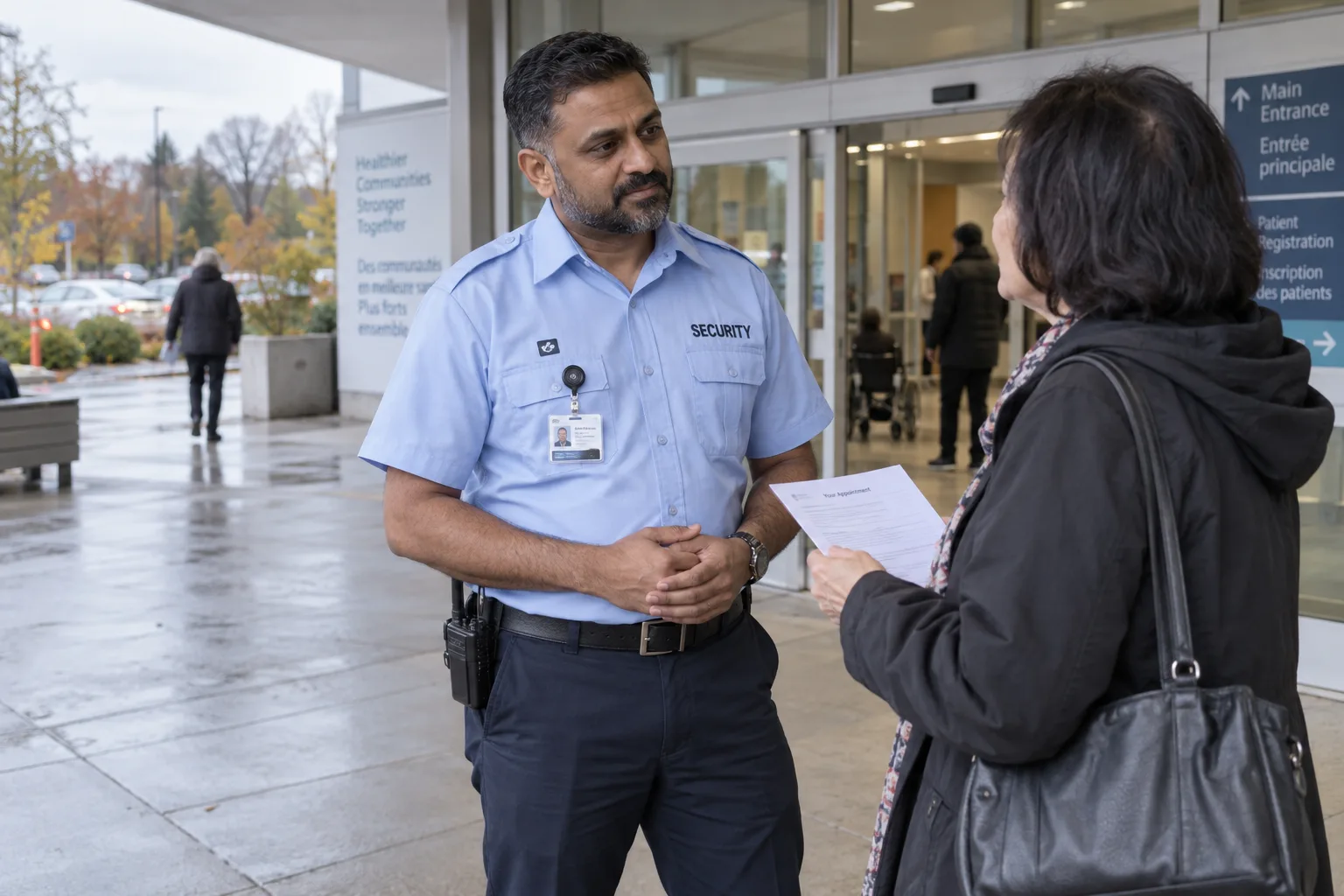
Workplace images are fictional AI illustrations created for Get Licensed. Country imagery reflects the referenced setting.
© 2026 Get Licenced LLC. All rights reserved. Source material retains its own rights.